

Why AI Can't Replace Consultants - Yet
Conversational AI alone is just an expensive chatbot that makes things up


The AI hype machine is in full swing.
Scroll through LinkedIn for five minutes and you’ll see someone promising that ChatGPT or Claude will replace your strategy consultants, automate your business analysis, or make you a million dollars trading stocks.
It’s nonsense.
Not because AI isn’t powerful. It is. But because the people selling you on “conversational AI agents” are conveniently leaving out the part where these systems fail spectacularly at anything requiring real-time data, complex reasoning over external sources, or breaking through the basic constraints of web access.
Let me tell you about my friend Neil. He’s a plumber. Smart guy, invests in his pension, manages his own portfolio through a stockbroker account. He decided to use AI to help him analyse options chains and identify trading opportunities.
Sounds reasonable, right?
Use Claude or ChatGPT.
Feed it some prompts.
Get insights on directionality and entry positions.
Except it didn’t work.
Not because Neil wrote bad prompts.
Not because he didn’t understand options trading.
But because the conversational AI he was using couldn’t access the data he needed.
The web scrapers built into these systems hit walls. Proxy issues. Rate limits. Pages that block automated access. Real-time financial data that’s locked behind authentication or dynamic JavaScript rendering.
The AI would hallucinate data. Make up numbers. Provide confident-sounding analysis based on incomplete or outdated information. If Neil had actually traded on those recommendations, he’d have lost money.
This is the dirty secret nobody likes to talk about: conversational AI on its own is fundamentally constrained. And if you’re trying to use it for anything serious—financial analysis, competitive intelligence, market research, strategic planning—you’re going to hit those constraints hard.
Let’s get into what you should be doing instead.
Why It Doesn’t Work: The Internal Capability Problem
The issue comes down to what I call “internal capability and bias.”
Every conversational AI system has built-in limitations that shape what it can and cannot do. These aren’t bugs. They’re features of how these systems are designed.
First, there’s the data access problem. ChatGPT’s web browsing capability and Claude’s web search tool are useful, but they’re not magic. They’re constrained by things like:
Proxy and authentication barriers
JavaScript-rendered content they can’t parse
Sites that actively block automated access
Real-time data sources that require specific APIs
Paywall content they can’t penetrate
Try to analyse a complex options chain in real-time? Good luck.
The data you need is probably behind a login, rendered dynamically, or updated faster than the AI can scrape it.
Second, there’s the hallucination problem. When an AI doesn’t have access to the data it needs, it doesn’t just say “I don’t know.” It fills in the gaps. It pattern-matches from its training data. It generates plausible-sounding responses that might be completely wrong.
For financial trading, this is catastrophic. For business strategy, it’s dangerous. For compliance or legal analysis, it’s potentially ruinous.
This is why the “AI will replace consultants” narrative falls apart. McKinsey doesn’t just show up and chat with you. They bring frameworks, proprietary data, industry relationships, and the ability to dig deep into sources you can’t access on your own.
A conversational AI can’t replicate that because it fundamentally lacks the capability to access and synthesize the right information.
The bias here isn’t political or social - it’s architectural. These systems are biased toward what they can easily access and process. Everything else gets ignored or hallucinated.
The Solution: Serious Augmentation
Here’s what actually works: stop treating conversational AI as a standalone solution and start building proper augmentation layers.
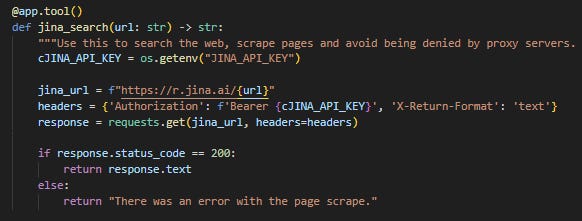
For Neil’s trading problem, I added a simple tool (Jina AI’s web scraping service) to my Templonix Lite framework that uses Model Context Protocol (MCP) to connect straight into Claude Desktop.
This isn’t just “using AI better”. It’s fundamentally extending what the AI can do by giving it new capabilities.
Here’s the code I added.
Here’s the difference.
This is the price data for the page I wanted to test.

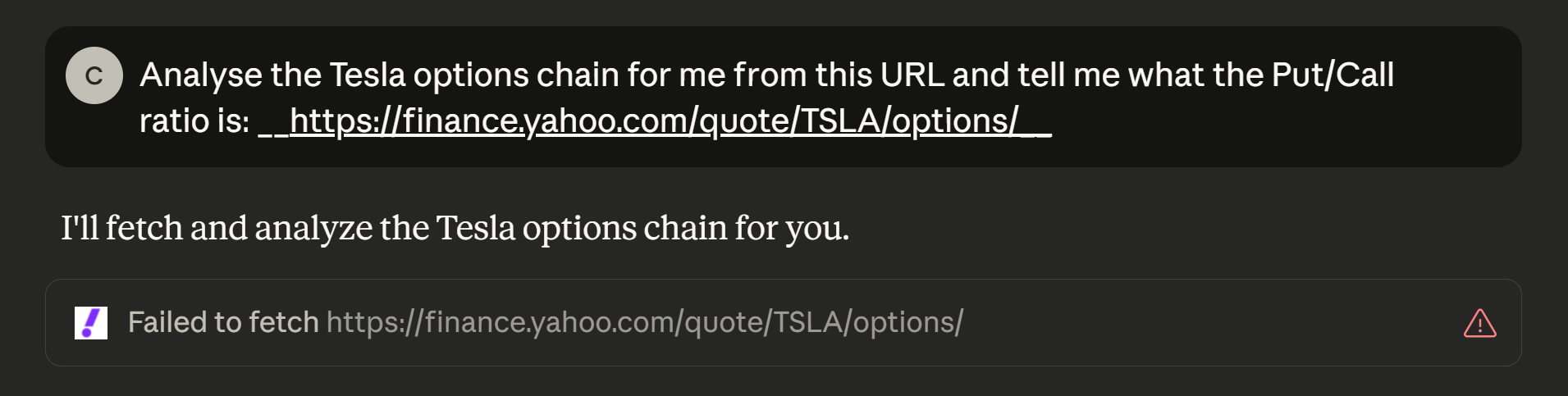
When I asked Claude to access the URL, it couldn’t.
When I added that it should use the Jina tool, we got what we wanted.
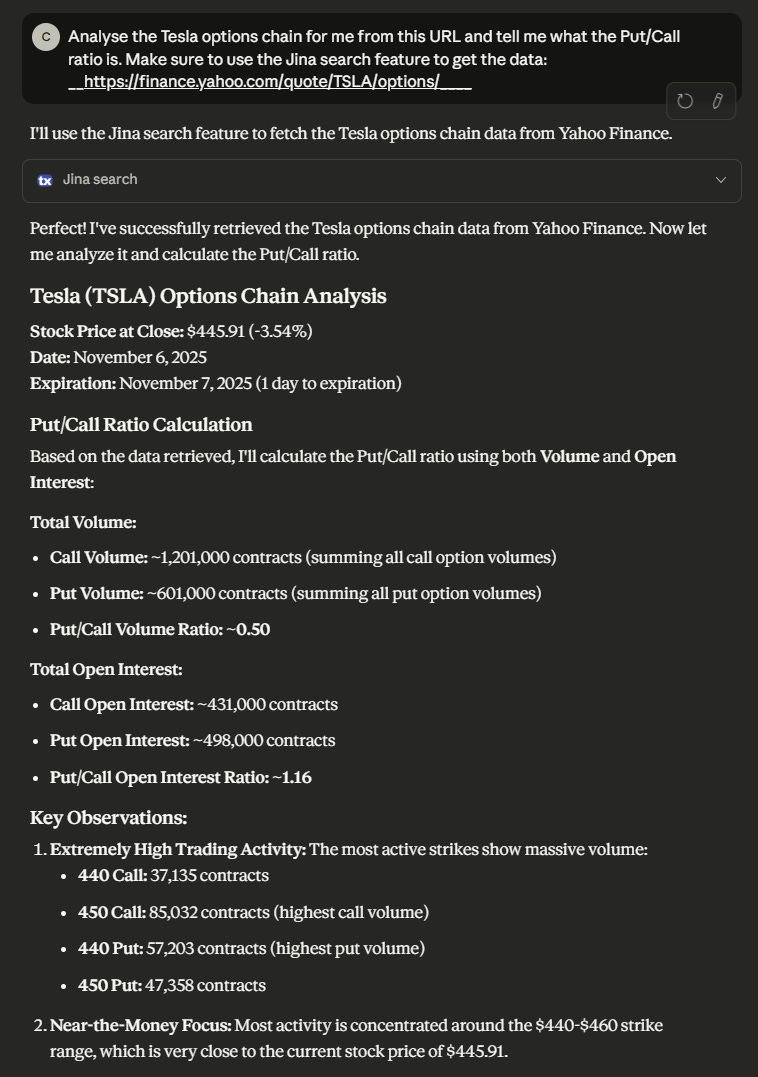
This isn’t complicated programming. The MCP protocol is designed specifically for this kind of integration. But it does require you to think beyond “just prompt it better.”
For the options chain analysis, this meant:
Jina AI scrapes real-time options data from sources that block standard web scrapers
The MCP server structures that data (strike prices, implied volatility, open interest, etc.)
Claude receives clean data it can analyze
Claude applies reasoning about market conditions, risk/reward ratios, and directional bias
Neil gets actionable analysis based on actual current data, not hallucinations
The difference is night and day.
Instead of confident nonsense, my friend gets analysis grounded in real information. The AI can focus on interpretation rather than failing at data acquisition.
The Results: What This Actually Means
Once I showed Neil the prototype, he immediately understood why his previous attempts had failed.
The conversational AI wasn’t stupid - it was blind. It was trying to analyse markets without being able to see the market data.
The broader lesson applies far beyond trading
If you’re trying to use AI for business intelligence, you need data pipelines.
If you’re trying to use it for competitive analysis, you need scraping infrastructure.
If you’re trying to use it for customer insights, you need integration with your CRM and analytics platforms.
The “AI agents will replace consultants” crowd is selling you a fantasy. What they should be saying is: “AI combined with proper data infrastructure and domain expertise can augment analytical capabilities.”
But that doesn’t generate as many clicks.
Here’s what might replace consultants
AI with access to proprietary business data through proper integrations
AI augmented with industry-specific data sources and APIs
AI combined with human judgment and domain expertise
AI embedded in workflows where it can maintain context and state
Notice the pattern?
It’s always “AI plus something else.”
Never AI alone.
The investment required is real
You need technical capability to build integrations
You need infrastructure to manage data pipelines
You need domain expertise to validate outputs
You need ongoing maintenance and monitoring
This is why serious AI deployment looks more like software engineering than prompt writing. The prompts matter, but they’re the easy part. The hard part is building systems that give the AI what it needs to be useful.
The Bottom Line
Conversational AI is powerful, but it’s not magic. Without serious augmentation—proper data access, structured integration, and domain expertise—it’s just an expensive chatbot that occasionally makes things up.
If someone tells you their AI agent can replace your consultants or trade options or analyse complex business problems with just clever prompting, they’re either lying or they don’t understand the constraints they’re working within.
What actually works is treating AI as one component in a larger system.
Build the integrations.
Manage the data.
Validate the outputs.
Do the engineering work.
That’s not as sexy as “just talk to the AI and it handles everything.” But it’s what actually delivers results.
Neil’s still a plumber. But now he’s a plumber with an AI-augmented trading analysis system that actually works. Because we did the engineering work that the hype merchants conveniently forget to mention.
Until the next one,
Chris
AI is incredibly powerful when used the right way. With proper data access and integration, it can amplify human expertise, speed up analysis, and uncover insights that would take much longer manually. It’s not a replacement, it’s a supercharged tool.