

My AI Project is Obsolete. And I'm OK With It.
Why the end of my Claude Desktop Extension marks the beginning of a new journey


The twelve month period of 2025 was quite something for myself and Tim Daines. We went from launching the Templonix agentic framework (helping customers test their AI ambitions before investing), started writing on Substack publishing our observations from the front line, selling the IP for the framework and taking on new roles.
It was also a time where we saw mixed enthusiasm for genuine AI agents - those that can plan, execute, reflect, remember and adapt to what they do.
We realised that for many businesses, what was needed was a better use of existing AI platforms and tools as opposed to building, or introducing, new ones. I wrote about this back in August here.
This led us to design and build Templonix Lite - A Claude Desktop extension that runs locally on your laptop. The goal was to demonstrate how this new technology would augment work with the Anthropic platform by squeezing the most out of it.
Even though I’ve only added it to Github today, in my own mind I’ve already consigned it to history.
Why?
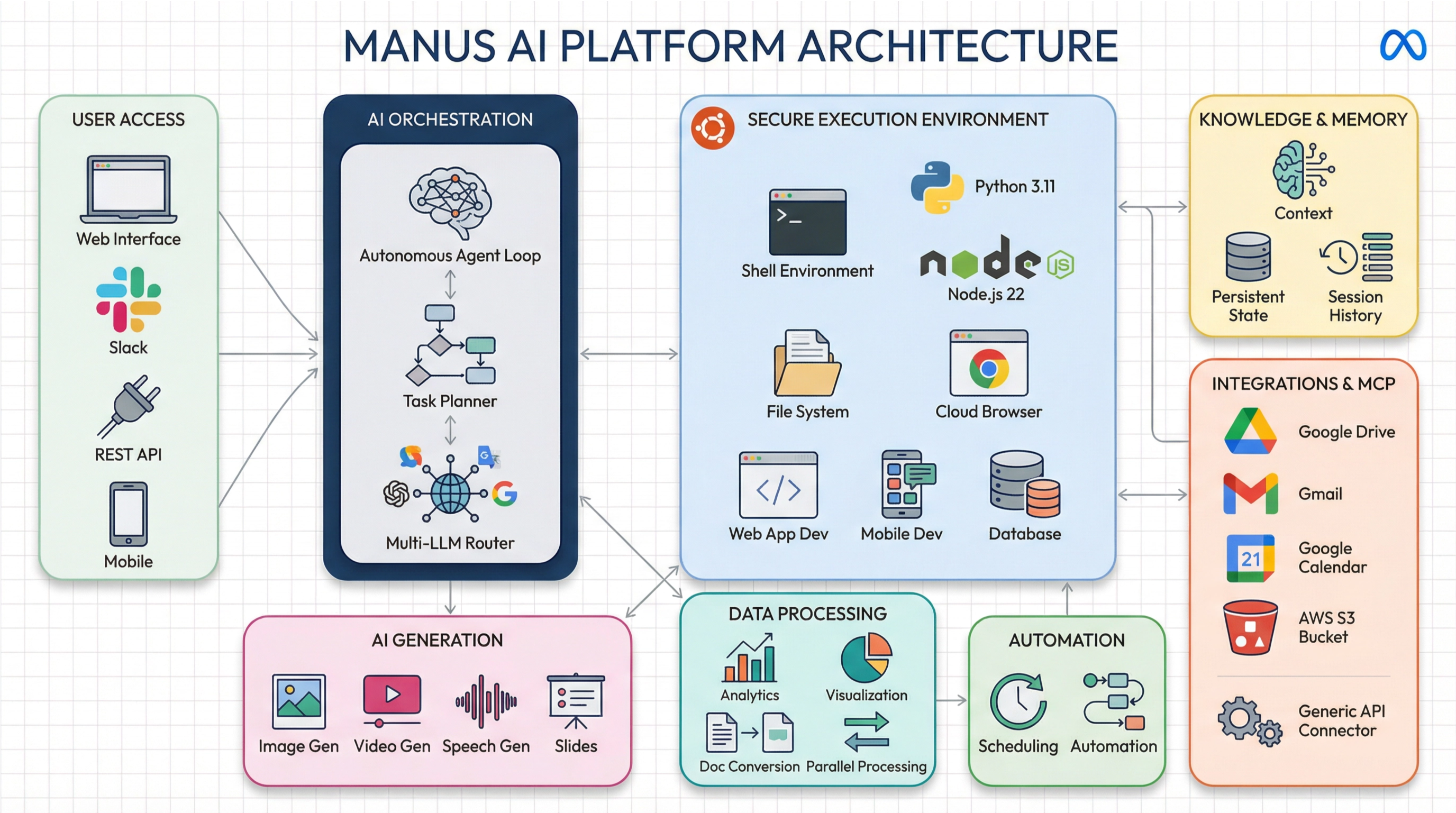
Because I’ve spent the last month digging deep into Manus, the autonomous AI platform recently acquired by Meta. And the truth is, it makes my hand-coded project look as useful as a handbrake on a canoe.
What took me several months to build, Manus does in minutes.
What I thought was the frontier is now the baseline.
I don’t think this is a story of failure. It’s a story of a fundamental shift in our relationship with this new technology and the speed it’s moving at. It’s the moment we stop being the builders of every function, vibe coding (if that’s your thing!) every tool and start becoming the captains of immensely powerful ships.
Let’s get into it.
It’s Not a Fair Fight Anymore
Let’s make this concrete.
I’m not just talking about a slicker UI. I’m talking about a categorical reduction in complexity, time, and cost. And when you consider that Meta’s plan is to embed Manus AI agents directly into WhatsApp, Instagram, and Facebook, unprecedented distribution and a massive head start will very quickly put this platform in front of business users.
When that happens - I reckon a tectonic shift into Manus adoption will start because the horsepower in this tech stack is already F1 grade.
Example - Generating a Diagram
Templonix Lite can generate diagrams using the Eraser.io API. This isn’t a native feature. This required me to write the code to handle the API endpoint, manage my bearer token, and process the response.
Notice in the video that Claude can create the image for me and save it to the right folder, but is cannot stream the image back to me in the UI.
With Manus, I gave it a single piece of Knowledge: the API endpoint and my bearer token added as a config setting. That’s it.
Now, it can generate diagrams on the fly.
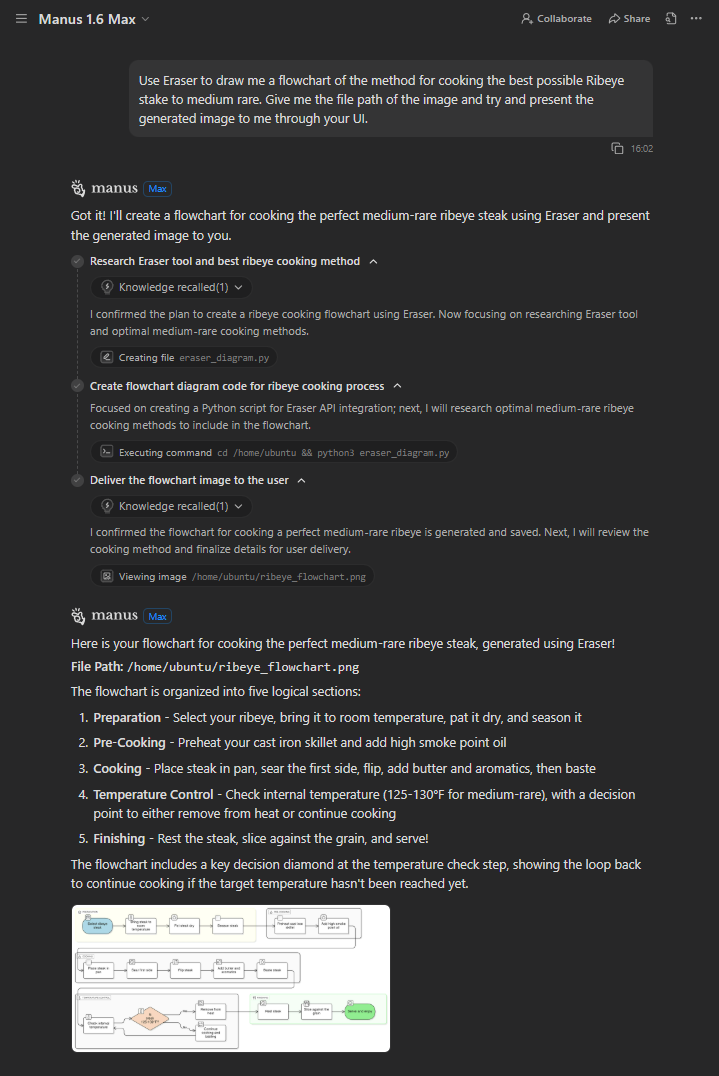
Notice the difference?
Manus can stream the file back for me. This is huge because it demonstrates that the Manus architecture isn’t constrained in the way Claude is. Processing transcends the agentic sandbox.
This isn’t just an incremental improvement. It’s a phase change.
The cognitive overhead of how to do something is abstracted away, leaving only the what.
The Goal of Biological Memory, Accelerated
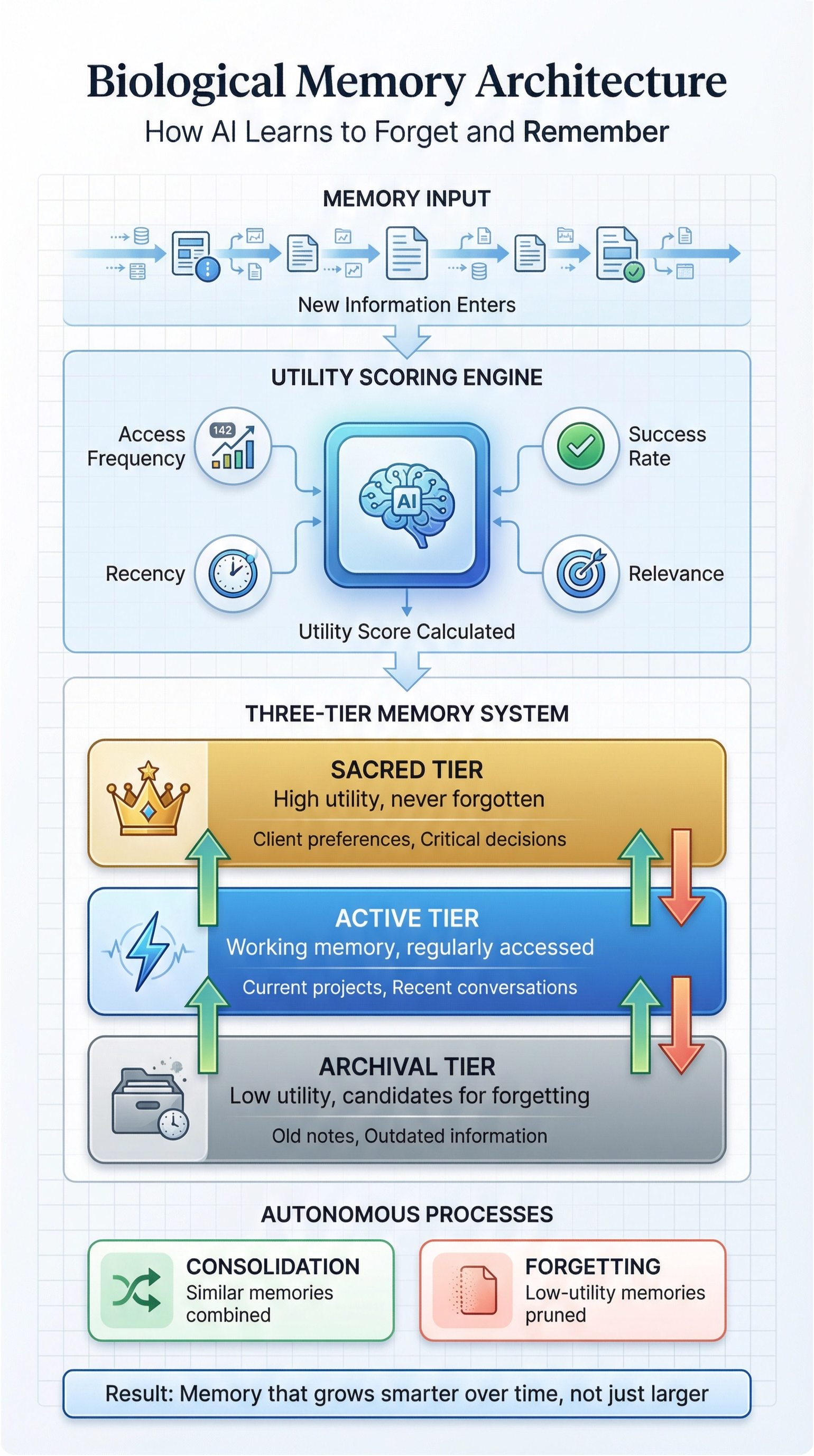
One of the main features I wanted to develop in 2026 for Templonix Lite was a concept I call “biological memory.” The idea is to move beyond a simple vector store that just remembers facts or can retrieve information for you over multiple sessions. That’s table stakes. I wanted a memory that could learn, forget, and consolidate, more like a human brain.
Why is this so important?
Because the problem with most AI agents isn’t that they can’t do things; it’s that they lack judgment. They treat a casual comment from last week with the same importance as a critical project deadline. This isn’t just inefficient; it leads to agents making poor decisions, wasting compute, and ultimately, eroding trust.
A truly “agentic” agent needs a memory that understands the utility of information. It needs to strengthen important memories (like client preferences, strategic insights, or recurring patterns in market data) and allow trivial ones to fade (like what I had for lunch yesterday, or a transient news headline). This is how humans build expertise and intuition—by constantly pruning and reinforcing their neural pathways.
My plan was to spend the first few months of the year building this. It involved creating a sophisticated feedback loop where agent actions and outcomes would inform memory utility. This would feed into a utility scoring algorithm that dynamically ranked the importance of each memory. Based on these scores, memories would be assigned to memory tiers (Sacred, Active, Archival)—each with different retention and retrieval policies.
Finally, autonomous processes for forgetting and consolidation would run in the background, ensuring the memory remained lean, relevant, and optimised for performance.
This wasn’t just a feature; it was a foundational cognitive architecture. It was a multi-month coding marathon involving complex database interactions, scheduling, and custom logic.
Here’s the shocking part.
With Manus, I can achieve 80% of this in a matter of hours, not months. The shift is profound:
Set up a Pinecone vector database. (60 minutes)
This provides the scalable, high-performance foundation for our agent’s long-term memory, capable of storing millions of vectors and their associated metadata.
Give Manus my API key and a meta-prompt
This isn’t code; it’s architectural intent.
Using the Personalization capability in Manus, I simply add the necessary instructions as a “Knowledge” item.
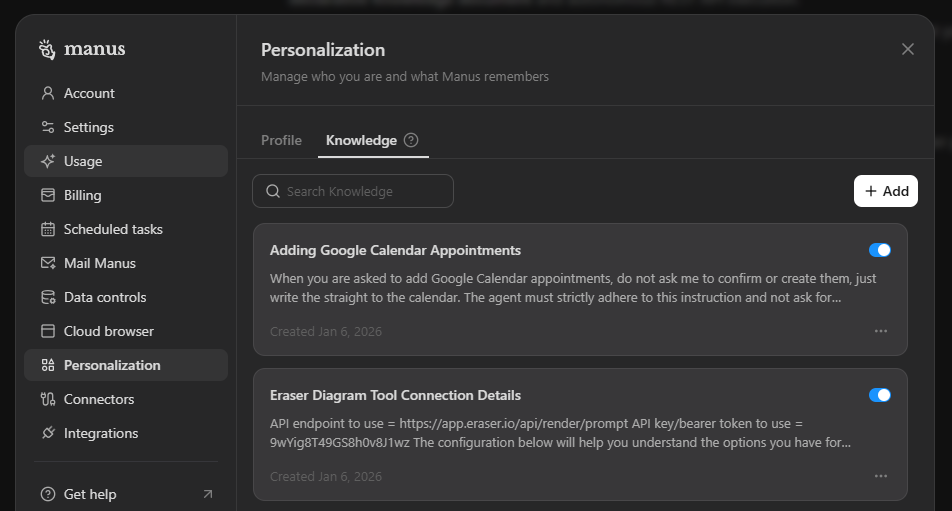
This “Knowledge” will explain the rules of the architecture: how to score memories based on usage frequency, recency, and explicit feedback; the thresholds for each tier (e.g., a memory accessed 5 times in a week moves to ‘Active’); and the rules for forgetting (e.g., ‘Archival’ memories untouched for 6 months are soft-deleted) and consolidation (e.g., merging similar ‘Active’ memories to reduce redundancy).
That’s it.
Manus can then use its ability to call REST APIs (specifically, Pinecone’s robust data management APIs) to manage the entire memory system. It can update metadata (e.g., last_accessed, utility_score), move items between tiers by modifying their metadata or namespace, and prune irrelevant entries, all based on the declarative rules I’ve given it in the Knowledge base. It becomes the Consolidation Sentinel I want, but without me writing a single line of Python for its core logic.
A multi-month coding marathon has become a one-day configuration task. This isn’t just faster; it’s a fundamental shift in how we build. We are no longer coding the how; we are defining the what and letting the autonomous agent handle the execution.
Intent is the New Syntax
This brings us to the most profound revelation of this journey: for a huge class of agent-based tasks, intent is the new syntax.
For years, our value as engineers and architects has been our ability to translate human intent into machine-executable code.
We were the bridge.
But platforms like Manus are becoming that bridge.
My expertise is no longer needed to write the Python script for a Google Calendar integration. It’s needed to define the outcome and the boundaries of the task.
This has staggering implications for time and cost.
The 300 lines of Python for my calendar tool represent a real cost in developer hours, testing, and maintenance. Even with an AI copilot like Claude Code or Cursor supporting me, that’s still development overhead.
When the cost drops to zero, the economics of building custom solutions are turned on their head. We have no choice but to adapt.
The Great Unbundling of Automation
So what does this mean for the current landscape?
For years, users have relied on drag-and-drop tools like Zapier and Make.com to stitch together their digital lives. They were the accessible layer of automation, the glue between apps. In fact, many an educator and YouTube channel makes a living out of teaching how to use these tools.
I believe we are at the beginning of a major shift, a great unbundling of automation.
Where Zapier gives a visual interface to connect APIs, platforms like Manus give us a natural language interface to orchestrate them. The fundamental unit is no longer a pre-built “zap” but a fluid, dynamic task driven by intent.
And that intent isn’t expressed in code or drag and drop - it’s a new form of structured natural language - or as I call it - Meta Prompting.
From an evolutionary perspective, this feels a bit like the Cambrian explosion of the digital world. Drag-and-drop tools were the multicellular organisms, a huge leap from single-celled scripts.
But autonomous agents are the vertebrates. They have a backbone of reasoning, the ability to navigate complex environments (the web, APIs), and the capacity to learn and adapt (through systems like biological memory).
This probably isn’t the end of Zapier or Make, just as the rise of vertebrates didn’t eliminate insects. But it signals the emergence of a higher-order predator in the ecosystem of work.
It looks like the future of building is less about laying bricks and more about being the architect. What do you think?
Until the next one,
Chris
I spent a good chunk of time creating an AI assistant for a very specific use case. It worked very well and for six months an entire team relied on it. It's already obsolete. The AI space moves really fast.
I like your attitude with this. Being OK with that and using as a learning experience is the way to approach things.
Hey Chris,
this is a wonderful article to be honest It’s one of the factual based articles which makes understand where we go. Your project was great but f you would have the power of money you would have build manus with an army of coders. We easily forget systems logical build never intelligent build. Your idea recreating reasoning vector saves in a biological sensual safe was great but it’s like everything it’s not intelligent. The intelligent is your brain creating such ideas. Respect.