

Moltbot Is a Warning. Here's What It's Really Telling Us
The viral AI agent's security nightmare exposes the gap that's keeping enterprise agents out of production


You’ve probably seen the headlines by now.
Moltbot, the open-source AI agent that went viral last week under its original name Clawdbot, has become the poster child for what happens when autonomous systems meet security reality.
The numbers are staggering. Over 85,000 GitHub stars. 11,500 forks. Hundreds of exposed control panels found on the open internet, with full access to private conversations, API keys, credentials, and the ability to hijack agents to run commands on users’ behalf.
One security researcher called it “an infostealer disguised as an AI personal assistant.”
Palo Alto Networks flagged that Moltbot “does not maintain enforceable trust boundaries between untrusted inputs and high-privilege reasoning or tool invocation.”
Cisco’s AI Threat Research team went further: “Security for OpenClaw is an option, but it is not built in. The product documentation itself admits: ‘There is no perfectly secure setup.’”
And here’s the part that should concern anyone building AI agents in an enterprise context: 22% of Token Security’s customers already have employees using Moltbot within their organisations - likely without IT approval.
This isn’t a fringe story about hobbyist developers misconfiguring their side projects.
This is a preview of what’s coming for every organisation racing to deploy autonomous agents without the security architecture to support them.
The uncomfortable truth?
Most enterprise AI agent platforms share the same fundamental weakness that made Moltbot a security nightmare.
They don’t have human context.
And without that, you’re not going to production.
No matter how good your agents are.
Let’s get into it.
What Moltbot Actually Exposed
The Moltbot disaster isn’t really about Moltbot.
Yes, these things ignore basic security hygiene. Yes, there are now malicious plugins, fake VS Code extensions, and crypto scammers squatting on the old handles.
But the core architectural problem? That’s everywhere.
Here’s what Moltbot was designed to do: run locally, connect to messaging apps, manage calendars, browse the web, read and write files, send emails on your behalf; all with persistent memory so it can learn and improve over time.
Sound familiar?
That’s exactly what every enterprise AI agent platform promises.
The difference is that Moltbot’s weaknesses played out in public. Enterprise agent failures happen behind closed doors, in pilot reviews that never get signed off, in compliance meetings where CIOs shake their heads, in security audits that flag “unacceptable risk” and kill the project.
The Palo Alto Networks team identified what they called the “lethal trifecta” for autonomous agents:
Excessive agency built into the architecture
No enforceable trust boundaries
External content directly influencing planning and execution without policy mediation
That trifecta doesn’t just apply to open-source agents running on developer laptops. It applies to any agent that operates without proper security context.
And in my experience working with enterprise customers over the last few weeks, that’s most of them.
The Pilot Graveyard
I’m been deep in conversations with organisations building agentic systems every day and there’s always a pattern to the discussions.
Most companies really don’t struggling with the AI part. The models work. The integrations exist. The use cases are valid.
What’s killing them is something far more boring: security context.
Businesses of all sizes want to expose processes as tools for their agents. MCP is the hottest topic of all in my world right now. Valuable data is sitting in their platforms and they want to get it out, make it accessible to reasoning systems, let agents orchestrate across their landscape.
But they can’t go to production. Not yet.
Why?
Because the moment an agent runs, someone needs to know: who asked what agent to do which task when, and what was the outcome.
Without that audit trail, CIOs and security leaders won’t sign off. Full stop.
This isn’t paranoia. This is governance.
And it’s preventing real deployments from leaving pilot purgatory.
The Problem Few Want to Discuss
Think about how most enterprise AI agent platforms are designed.
The agent runs under the context of a system account and operates within a runtime environment.
That works fine for automation, where an agent is isolated to a particular task or integration.
But agents aren’t automation. They’re supposed to be making decisions. They are invoked by humans and in sophisticated use cases, they delegate tasks to other agents. They operate with degrees of autonomy that traditional systems never had.
And here’s the uncomfortable bit: most agent platforms don’t have human context.
There’s no identity delegation. No user-level audit. No way to trace a decision back through the chain of who authorised what.
This is exactly what made Moltbot so dangerous. As one researcher put it: “Malicious links from unknown senders will be treated with the same level of security as a message from family.” The agent couldn’t distinguish between trusted and untrusted inputs because it had no context for trust.
Security leaders aren’t stupid. They see this gap.
And they’re not approving production deployments until it’s closed.
Risk Is the Surface Area
The Moltbot situation has forced me to rethink how I frame the adoption conversation. The conventional wisdom says: more governance, more security, more team capability equals better AI readiness.
But that’s not quite right.
I’ve built a tool that calculates your Coverage vs Surface Area ratio and tells you whether you’re Aligned, Overextended, or Underutilised. It also breaks down where your gaps are across Security, Governance, and Team.
You can get a copy of the AI Agent Strategy Assessment at the end of this post.
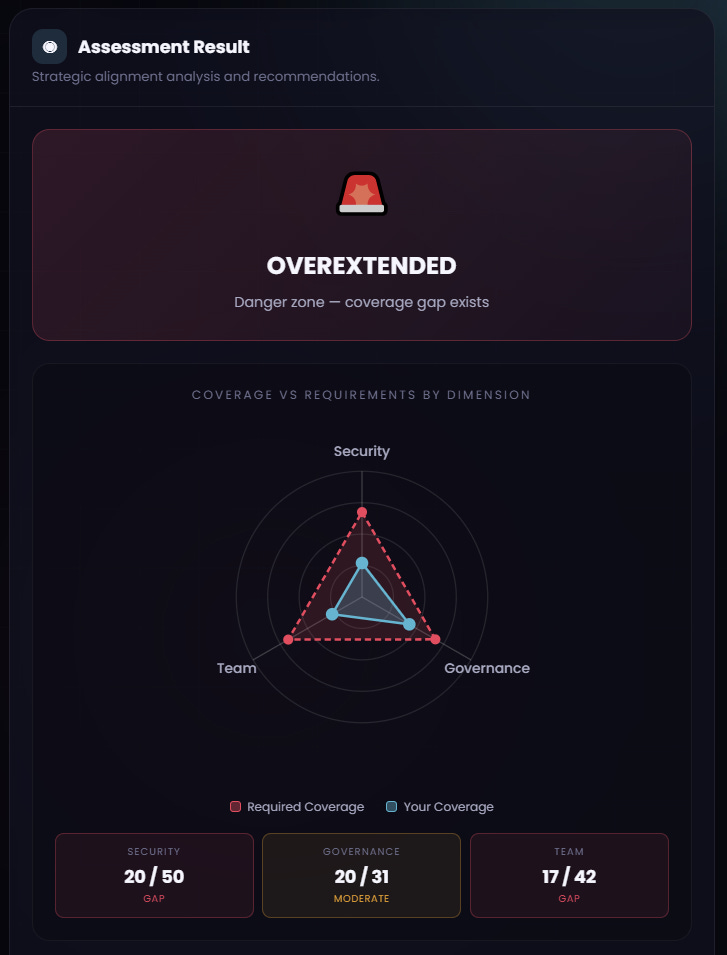
What actually matters is whether your protective capacity matches your actual exposure. I’ve started calling this Surface Area Analysis - and it changes how you assess agent readiness.
I’ve built a tool for
Here’s the core idea.
Your coverage is the sum of your investments across three dimensions:
Security — Technical controls, threat detection, audit trails, incident response
Governance — Policies, compliance frameworks, accountability structures
Team — Skills, training, organisational readiness
Your surface area is your actual exposure—driven by:
AI Maturity — How sophisticated is your organisational capability? (Lower maturity = higher risk per agent)
Security Maturity — How robust is your existing security posture? (Weaker = more vulnerable)
Agent Count — How many agents are you running?
The insight: lower maturity increases your surface area. When organisational capability is weak, each agent carries more risk. You need more explicit controls to compensate.
Moltbot users learned this the hard way. Many of them were technically sophisticated developers who assumed they understood the risks. But they deployed without baseline security protections, left control panels exposed, and integrated third-party plugins without auditing them.
Their surface area was massive. Their coverage was non-existent.
Enterprises make the same mistake in reverse. They assume that because they have governance frameworks and security policies, they’re covered. But those frameworks weren’t designed for agents. The policies don’t address identity delegation or autonomous decision-making.
The coverage looks robust on paper. In practice, it’s full of holes.
The Three States
Divide your coverage by your surface area. You get one of three results:
Aligned (Ratio ≈ 1.0) — Your investment matches your risk. Optimal state.
Overextended (Ratio < 1.0) — Your surface area exceeds your coverage. You’re deploying faster than you can protect. This is the danger zone—and where most enterprises stuck in pilot purgatory actually sit.
Underutilised (Ratio > 1.0) — Your coverage exceeds your surface area. You’ve over-invested in protection relative to what you’re actually running. Resources are locked up.
It’s common to see organisations assume they’re underutilised, they think they need more governance before they can move.
The reality is often the opposite.
They have plenty of governance capacity. What they’re missing is security context at the agent level. Without it, no amount of policy paperwork gets them to production.
Why This Is Preventing Production Deployments
Let me make this concrete.
If you choose to build agents for your business (whether buy or build) the project naturally requires:
Technical infrastructure (compute, networking, deployment pipelines)
Operational capability (release management, testing, version control)
Data access and integration
Human beings to do the work
These are table stakes. Every IT project has needed them since forever.
But if you can’t fit the project inside a security and governance envelope, you leave yourself exposed to a wide surface area of agentic risk.
And here’s the cascade:
If you don’t have the right skills, you can’t build the right thing. No point worrying about data.
If you can’t govern the agents, no point worrying about data.
If you can’t secure the agents, why are you worrying about data at all?
Security comes first. Not because it’s the most exciting part, but because without it, everything else is irrelevant.
The Moltbot situation proves this at consumer scale. Hundreds of exposed control panels. Malicious plugins distributed through the official skills marketplace. Prompt injection attacks leaking private data. Remote code execution vulnerabilities allowing full system compromise.
That’s what happens when security is an afterthought.
Now imagine that happening inside your enterprise. With customer data. With regulated processes. With agents that have access to your ERP, your CRM, your financial systems.
Security leaders aren’t going to approve that. Not until the gaps close.
What To Do About It
If you’re stuck in a cycle of never ending pilots, here’s how to diagnose the problem:
Step 1: Map your current coverage
Score your organisation across Security, Governance, and Team. Be honest. If your agent platform runs under a system account with no user-level audit, your security coverage is lower than you think.
Step 2: Calculate your surface area
How many agents are you running?
What’s your AI maturity?
What’s your security maturity?
Lower maturity scores mean higher surface area, each agent carries more inherent risk.
Step 3: Find the ratio
Coverage divided by surface area. If you’re below 1.0, you’re overextended. That’s your signal to pause deployment and close gaps before pushing forward.
Step 4: Prioritise security context
For most enterprise teams, the specific gap is human identity context for agent operations. That’s what’s blocking production approval. Focus there.
The Bottom Line
Moltbot isn’t an anomaly. It’s a preview.
The same architectural weaknesses that turned it into a security nightmare exist in most enterprise agent platforms. The difference is that Moltbot’s failures happened in public. Yours will happen in compliance reviews and security audits, quiet deaths that never make the headlines.
The companies getting agents to production aren’t the ones with the biggest AI budgets.
They’re the ones who figured out that security context is the gate - and invested in closing that gap before scaling deployment.
Everyone else is stuck building fortresses around empty courtyards, wondering why leadership won’t approve the move to prod.
The answer is simpler than you think. And it has nothing to do with the AI.
Until next time,
Chris
You can get a copy of the AI Agent Strategy Assessment Tool here
This perfectly articulates something I've been thinking about — the "pilot graveyard" phenomenon is real. What strikes me is how the Moltbot situation mirrors the early days of cloud adoption, where security was bolted on after the fact rather than designed in. The Coverage vs Surface Area framework you outline here is exactly what enterprise teams need. One question though: do you think there's a role for agent-to-agent trust protocols (similar to service mesh auth in microservices) that could help close the identity gap, or does the human context always need to be the root of the chain?
The 'lethal trifecta' framing is useful, but I'd push back slightly on the conclusion that this is primarily a security context problem. What Moltbot really exposes is something deeper: we're building agents with the assumption that autonomy is the goal, when maybe the real question is which decisions should be autonomous at all. The coverage vs. surface area model is helpful, but it still accepts the premise that more agents = more value. Sometimes the answer is fewer agents with tighter scope.